7,379 puzzles never seen in development
All solved
 ZIGU LABS
An independent AI architecture beyond Transformers and LLMs
Extreme Sudoku, 100% solved Without an LLM like ChatGPT, a sovereign AI that reasons from its own memory
GBR runs even on a palm-sized mini computer.
REASONING RESULT
From the 422,786 public test puzzles of Sudoku-Extreme, an ultra-hard Sudoku dataset, 10,000 were drawn by a rule fixed before any result was seen. GBR's reasoning engine solved every one in a single attempt, with no guessing or backtracking, and an answer certificate for every puzzle is on GitHub together with a checker anyone can run. (The certificates show that each answer is the unique solution of its puzzle, and we hold the run records showing that these answers came from the GBR reasoning engine. Because of concerns such as reverse engineering, the detailed data of the reasoning process can be viewed through an agreement such as an NDA.)
All solved
All solved
You can check it on GitHub
ON-DEVICE DEMONSTRATION
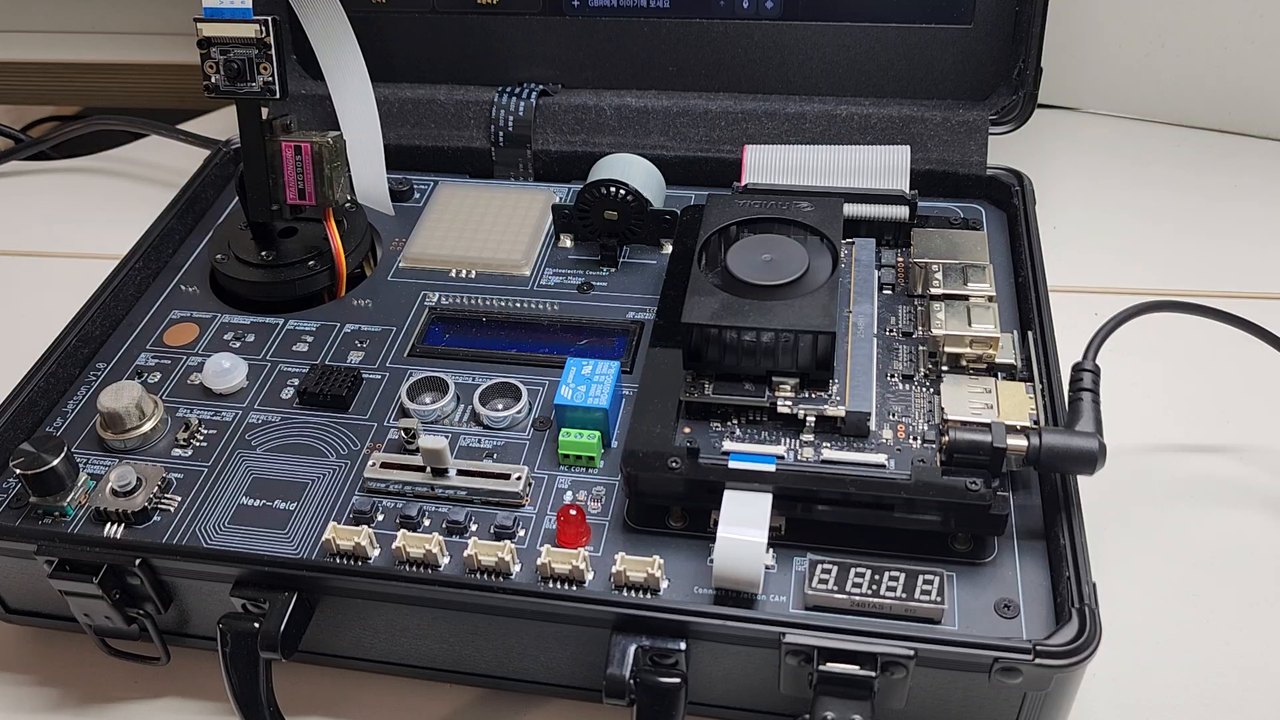
Filmed on an NVIDIA Jetson Orin Nano Super with 8 GB of memory, with the network cut off. It answers from stored knowledge and learns and retracts new knowledge on the spot. It moves a camera and a motor with natural language.
Execution demonstrated on the real device
 Watch the demo on YouTube
Even with no network, it reads the knowledge stored on the device and answers with its sources.
Taught one sentence, it uses it from the very next question, with no restart or retraining.
Retracted knowledge is no longer used, and the record stays.
It checks for safety before moving, then operates the servo motor and the camera.
PERSISTENT MEMORY
Knowledge lives not in weights but in memory units with a source and a version. Add, correct or retract one and the very next answer reflects it, with no retraining, and what changed stays on record. When the evidence conflicts it asks back; when there is none it says it does not know.
Demo video 8:08 — we asked about a company it had not learned.
What is ZIGU LABS?
I have not learned that yet. I read it as "ZIGU LABS" — did I read it correctly?The real conversation from the demo video (8:02–10:10), condensed from the on-screen text.
Watch this part of the video →The same form repeats at every size, from a single memory to groups and groups of groups, so even as memory grows, only the parts needed can be found and read. Our embedding is developed in-house too.
Within a stated scope it finds every memory closest to the question without missing one; outside that scope it says so or holds the answer. This is Zero-Miss search.
Knowledge is not held in RAM all at once: only the memories needed at that moment are streamed from storage, so a small device can use a large memory.
Publishing, correcting and retracting knowledge are all database operations. How long each memory is kept can be set individually.
Images, sound and sensor input come in through our own perception engine.
It understands the subject, the intent and meanings such as time, negation and conditions.
It argues over memory by deduction and induction, and decides whether to answer, ask back or hold.
It puts the decided meaning into words and links the evidence used.
Out as speech, text and motion (actions later).
ARCHITECTURE
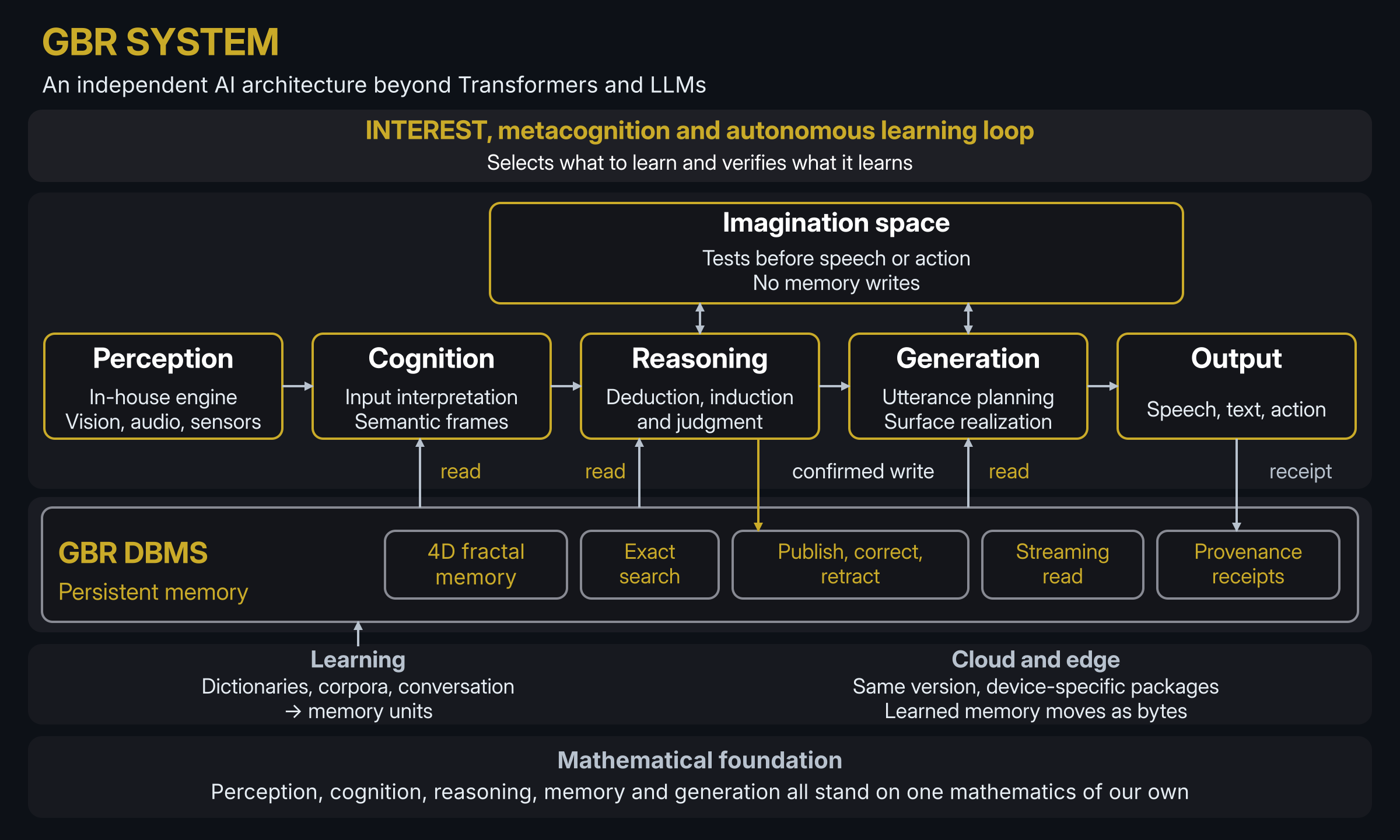
Perception that sees and hears, cognition that understands, reasoning that argues by deduction, induction and more, and generation that composes speech all rest on the same mathematical framework of our own, and connect through the 4D fractal memory. It is a structure with no dependence on Transformers or LLMs.
Before speaking or acting, it first tests in an imagination space. With evidence it answers; when the evidence is split it asks back; without evidence it says it does not know.
GBR SYSTEM has two main parts. GBR DBMS, which stores and finds data GBR AI, which handles perception, cognition, reasoning, generation and output The two are connected around memory. All the engines are our own.
Through our own active foundation named INTEREST, metacognition and an autonomous learning loop, it aims to choose what to learn by itself and to verify what it has learned separately.
| Weight-based language model | GBR | |
|---|---|---|
| Reasoning | Continues text token by token | Reasoning over memory, tested in an imagination space before answering |
| Where knowledge is stored | Spread across trained weights | Versioned memory units |
| State per step | A context window that grows with the conversation, up to a limit | A fixed-size dialogue state, plus memory queried on demand |
| How learned results are applied and changed | Retraining or fine-tuning | Publishing, correcting and retracting memory units |
APPLICATIONS / WHAT COMES NEXT
Even where there is no connection, the device sees, hears and decides on its own. Without an expensive server, a company or a person can put in the knowledge they need and have an AI of their own.
The first application area: one low-power small computer, no external server.
We are building a platform where manufacturers teach, change and use product knowledge on their devices. GBR PHYSICAL AI STUDIO, which connects device registration, licensing, updates, testing and reports, is its operating tool.
Cloud and device run the same GBR. Learned memory moves to the device, and the two are designed to share memory with each other.
An AI built and controlled by ourselves, not resting on foreign technology. On our own cognitive engine and memory store, companies and people manage their own knowledge and operating environment.
A CLOSER LOOK
No. We built our own DBMS and our own AI and wove them together. Understanding questions and composing answers use no Transformer or LLM, and no external LLM is called.
All it needs is data. Through our own embedding and GBR AI, knowledge is stored as memory units with a source and a version. Publishing new knowledge, correcting it or retracting it are database operations, so the next answer reflects the change with no retraining. Our goal is to digest every kind of unstructured data.
A memory structure in which the same form repeats at every size, from a single memory to groups and groups of groups. Even as memory grows, only the part that is needed is found and read.
By default, a memory lasts as long as it is not damaged. As storage fills up, however, memories come to need a time limit. You can set how long each memory is kept. It follows changes, and keeps what must be remembered for a long time.
It finds what it needs in memory, then assembles and checks it in an imagination space. Correctness is kept in three layers: it finds the supporting memories exactly, verifies its reasoning with certificates, and tests in the imagination space before speaking. When evidence falls short, it says it does not know.
In short, the problems that arise in discrete updates and variational computation. It is a mathematical framework for the long-standing problems that arise when an AI updates and computes information. Perception, cognition, reasoning, memory and generation all stand on it.
Download the original dataset (from Hugging Face) and run the checker from the GitHub repository, and anyone can use the answer certificates to re-check that each of the 10,000 answers is the unique solution of its puzzle. All 10,000 were also verified with an independent checker we did not write. The certificates show that the answers are correct; that these answers came from the GBR reasoning engine rests on our internal run records.
The current demo ran on a single NVIDIA Jetson Orin Nano Super with 8 GB of memory, with the network cut off. Knowledge lives in memory on the device, so it answers with no external server and handles devices such as a camera and motor in natural language. Smaller and larger devices are planned next.
It still has much to learn. It answers questions from knowledge learned in numbers and Korean, and learns and retracts new knowledge through conversation. It has not learned much data yet, so it is not as fluent as LLMs or as striking at generation, but it clearly works. (It is built in Korea, so for now it has learned only Korean and numbers.)
Makers of small devices and robots, and researchers in machine learning, databases, speech and robotics. Together we define the task, the device constraints, the memory and interfaces needed, and the scope of a technical review and a PoC.
BUILD WITH ZIGU LABS
From technical questions and research to product partnerships — let's talk about knowledge and intelligence that need sovereignty.